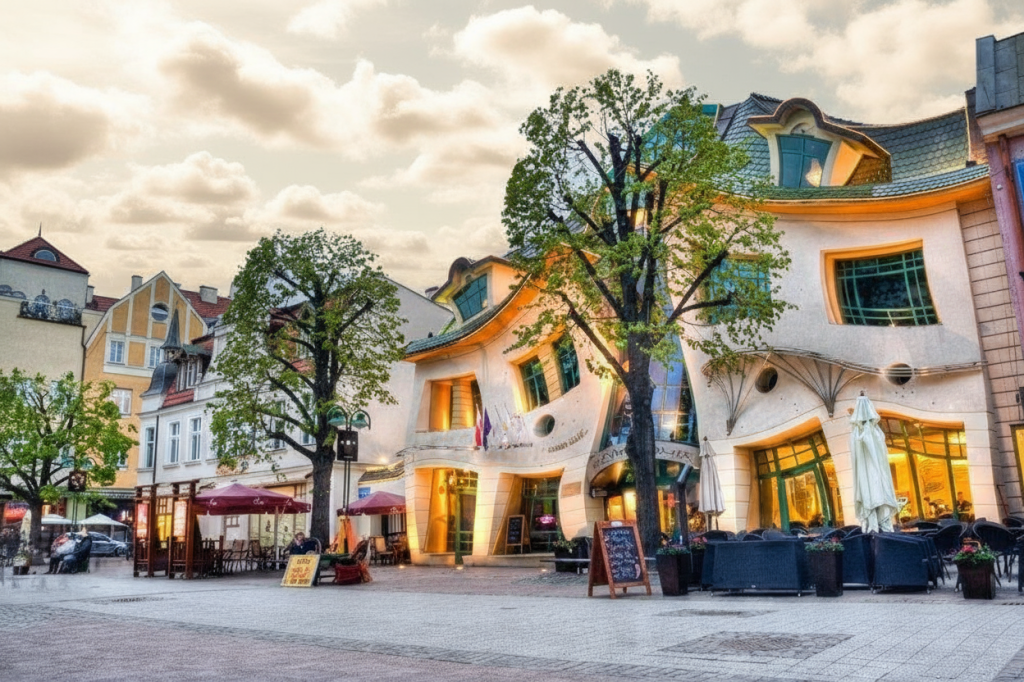
Wit may feel spontaneous, but it follows patterns—a kind of visual grammar.
There are specifically 7 strategies that can be used to create witty designs.
Exaggeration to stretch meaning, metaphor to link ideas, anthropomorphism to humanise objects, reversal to put form and function in tension, surprise to shift expectation, irony to provoke reflection and boldness to dare doing things differently. Recognising these elements helps us understand why certain designs make us pause, smile, or remember. They’re not tricks—they’re structure.
1. Exaggeration: Designers amplify form, scale, or colour to catch attention and provoke emotional responses. Exaggeration makes the familiar seem new, inviting curiosity and sometimes humour. Recent design trend analyses show that exaggerated elements are central to immersive experiences and “hyperrealism,” driving engagement and making visual wit unforgettable.[1]
2. Metaphor: Visual metaphor links unrelated ideas, giving recognisable aesthetics new meaning. It can be a witty tool used to link technical, conceptual, practical, and artistic aspects, enabling designers to craft spaces imbued with meaning and cultural significance.[2]
3. Surprise: Surprise disrupts expectations—a sudden twist in color, form, or concept prompts a “double take,” making the viewer pause, smile, or reflect. Designers intentionally introduce surprise to provoke reflection, creativity, and emotional engagement, enhancing the meaningfulness and memorability of the experience. The balance between predictability and surprise is crucial, allowing users to recognise disruption while maintaining comprehension. By fostering moments of surprise, designers open new possibilities for interpretation and interaction, making design outcomes more dynamic and impactful. Surprise thus acts as a key mechanism to deepen the connection between users and designed environments or objects.[3]
4. Anthropomorphism: Giving human characteristics to objects, or spaces can drive empathy and delight. Facades that display harmonious, symmetrical, and clearly recognisable human-like (face-like) patterns tend to elicit positive feelings such as pleasure, comfort, and a sense of connection. People are more likely to feel engaged and emotionally attached to buildings with friendly or appealing anthropomorphic cues. This can contribute to overall well-being and positive perceptions of urban environments.[4]
5. Reversal: Reversal flips conventions, turning norms upside down to challenge expectations. By inverting typical associations or design structures, reversal creates humour and critical thinking. Inversion enables architects to pursue innovation—not by merely designing new buildings, but by reimagining, reinterpreting, or even “unbuilding” existing structures or principles.[5]
6. Irony: With irony, designers use smart and layered humor to challenge traditional norms and provoke thought. It is a difficult task since irony can easily be interpreted as sarcasm or misunderstood altogether. Designers need to be very mindful of the culture, surroundings, and purpose in order to succeed and deliver an outcome that is experienced positively.[6]
7. Boldness: None of the above would be possible without boldness. Being confident, courageous, and willing to take creative risks—often standing out through strong, daring, or unconventional choices in design and visual expression.[7]
WHY THIS MATTERS
Wit in design is not decoration—it is a language of meaning. Together these strategies form a grammar designers use to communicate visually, with clarity and delight—turning objects or buildings into stories and hopefully bring more joy and overall well-being into their lives.
Image: Crooked House, 2004, Sopot Polland, Designed by Szotynsky & Zalenski
[1] The Power of Scale: How Proportions Shape Human Experience
[2] Architecture: The Making of Metaphors 2012
[3] Expecting the unexpected: A review of surprise in design (2024)
[4] Predictors of explicit and implicit anthropomorphism in house facades (2024)
[5] Architecture as the Inversion of Architecture (2016)
 THE ARCHITECTS OF WIT