Not everyone laughs at the same things—and not every wink in design lands the same way. Cultural background, personal history, and even mood shape what we find funny, clever, or delightful. Wit in design is therefore subjective, but not arbitrary. It follows recognisable psychological patterns and aesthetic triggers that connect across human experience.[1][2]
Across studies of perception and cross-cultural behaviour, certain mechanisms consistently emerge: humans react to surprise, notice tension and exaggeration, and are drawn to anthropomorphic or expressive forms. When the expected is disrupted—a façade turned inside out, a column that looks too playful to stand—the brain registers novelty and releases small surges of dopamine and endorphins, the same neurochemicals tied to laughter and insight. The essence of wit in the built environment lies in this neurological choreography: balancing expectation and subversion, intellect and emotion.
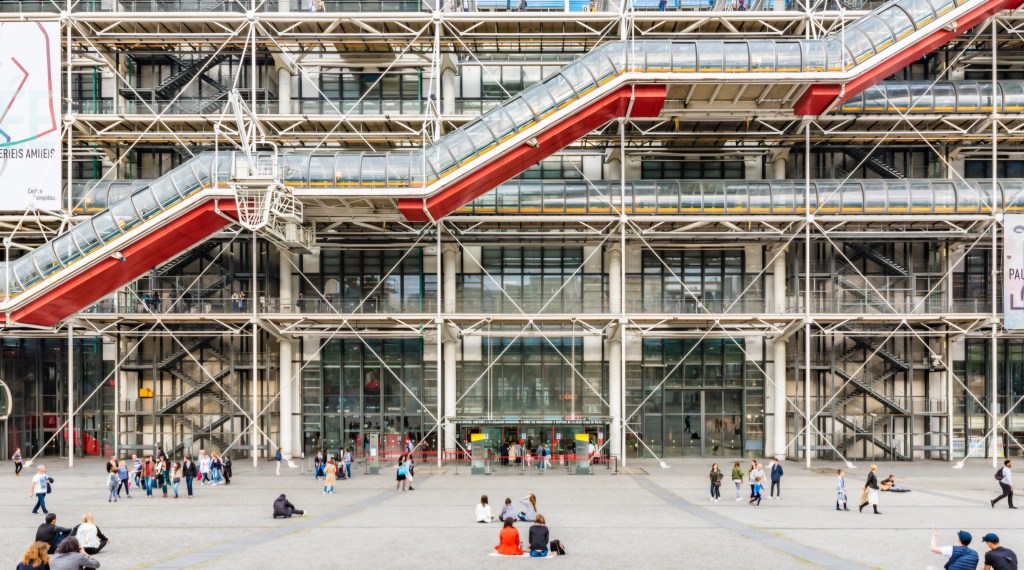
When Richard Rogers and Renzo Piano unveiled the Centre Pompidou in 1977, Paris was scandalized. Locals nicknamed it “an oil refinery in drag.”
Rogers famously replied, “We turned the building inside out so people could see how it works. If it looks different, that’s because it is different.” What the press mocked, neuroscience would later affirm: the Pompidou’s playful inversion of structure provokes cognitive dissonance and—once understood—delight. It transforms exposure into revelation, function into humor, and shock into curiosity [3][4][5].
The key, then, isn’t to design a universal joke but to understand how visual humor operates—through contrast, rhythm, timing, and empathy. Wit in architecture functions best when it disarms, invites reflection, or reawakens the childlike pleasure of discovery. Because ultimately, the goal is not only to amuse but to connect—to turn architecture into a living conversation between the mind, the senses, and the city itself.
Image: Centre Pompidou 1977, Paris, designed by Richard Rogers and Renzo Piano
[1] Cultural Differences in Humor Perception, Usage, and Implications
[2] Understanding the Subjectivity of Humor: Contextual and Psychological Factors in Humor Appreciation
[3] Centre Pompidou: high-tech architecture’s inside-out landmark
[4] Richard Rogers interview: Pompidou Centre “captured the revolutionary spirit of 1968” | Dezeen
[5] Richard Rogers + Architects
 THE ARCHITECTS OF WIT